
Quick answer: To get rid of a refrigerator smell, empty the fridge, throw out anything spoiled, and wash every shelf, drawer and wall with 1 tablespoon of baking soda per quart of warm water. Clean the door gasket and drip pan, dry everything, then set out an open box of baking soda or activated charcoal for a few days. Keep the fridge at 40°F or below so food spoils more slowly.
Knowing how to get rid of smell in refrigerator compartments comes down to one rule: find the source before you deodorize. Air fresheners and a box of baking soda can’t keep up with a leaking package of chicken stuck under a crisper drawer.
Most fridge odors clear up in an afternoon of cleaning. Stubborn smells, like those after a long power outage, take a few days more.
Why does my refrigerator smell bad?
Cold slows bacteria and mold down but doesn’t stop them. Anything that spills, leaks or gets forgotten keeps breaking down, and the liner and seals absorb the smell. The usual culprits:
- Spoiled or forgotten food. Leftovers in the back, soft produce, or a container that leaked onto the shelf below.
- Spills under drawers and shelves. Meat juice, milk and brine run into seams and under crisper drawers, where you never see them.
- A dirty door gasket. The rubber seal’s folds trap crumbs, drips and moisture, and mold can grow there.
- The drip pan. Many fridges have a pan near the bottom, often behind the front kick plate, that collects defrost water. Spills and food bits that wash into it can sour.
- A clogged defrost drain. If water pools under the crisper drawers or ice forms on the back wall, the drain may be blocked and the standing water starts to smell.
- The ice maker and water filter. Old ice absorbs odors, and an overdue water filter can make water and ice taste or smell off.
- A power outage. Food that warmed up during an outage spoils fast, and leaked fluids can soak into the liner.
One more cause people miss: a smell that seems to come from the fridge but is actually behind or under it. Mice like the warm space near the compressor. If you see droppings when you pull the fridge out, our guide on how to get rid of mice covers what to do next.
Is a smelly fridge a food safety problem?
Not always, but don’t use your nose as the test. The FDA points out that food can make you sick even when it doesn’t look, smell or taste spoiled, because the bacteria that cause illness are different from the ones that cause spoilage. A fridge that smells fine still needs to be cold enough.
How to get rid of smell in refrigerator shelves and drawers: step by step
- Unplug or turn off the fridge, and empty it. Put food you’re keeping in a cooler with ice packs, and check your owner’s manual for model-specific cleaning steps.
- Sort and toss. Throw out anything spoiled or questionable. Wipe sticky jars and bottles you’re keeping.
- Pull out shelves and drawers. Let glass shelves warm up before washing so they don’t crack. Wash removable parts by hand in warm water with dish soap. GE advises against putting plastic fridge parts in the dishwasher.
- Wash the interior with baking soda. Mix 1 tablespoon of baking soda per quart of warm water, the solution GE and Texas A&M AgriLife Extension both recommend. Wipe the walls, ceiling, floor and shelf seams.
- Scrub the door gasket. Open each fold of the seal and wipe it with the same baking soda solution. Dry it completely. If you see black spots that won’t come off, the gasket may need replacing.
- Check the drain and drip pan. Look for standing water under the crisper drawers or a frozen drain hole on the back wall. Your manual shows how to clear the drain on your model. If you can reach the drip pan, pull it out, wash it with warm soapy water and let it dry before putting it back.
- Sanitize after spoiled meat or an outage. If raw meat juice or spoiled food leaked inside, the University of Nebraska–Lincoln Extension recommends washing with hot water and detergent, then rinsing with a solution of 1 tablespoon of unscented liquid chlorine bleach per gallon of water. Check your manual first: some manufacturers, including GE, say not to use bleach on the interior.
- Dry and air it out. Dry every surface with a clean towel and leave the door open for about 15 minutes, as the UNL Extension suggests. Moisture left behind brings smells back.
- Restart and wait before reloading. Turn the fridge back on and let it get cold, then return food. Put an appliance thermometer inside so you know it’s reached 40°F or below.
- Absorb what lingers. Set out an open box of baking soda or a tray of activated charcoal. Most leftover smells fade within a few days.
If you use bleach to sanitize, use only unscented liquid chlorine bleach diluted as directed, wear gloves, open a window, and never mix bleach with ammonia, vinegar or other cleaners, because toxic gas can form. Rinse and dry surfaces before food goes back in. Keep kids and pets away from cleaning solutions. Unplug the fridge before cleaning near the back, the coils or the drip pan, and don’t use sharp tools to chip ice out of a frozen drain.
What not to use
GE warns against bleach or ammonia on the interior because they can damage it, and against lemon-scented cleaners, which can soak into plastic parts and leave their own smell. Skip scented air fresheners too: food absorbs them.
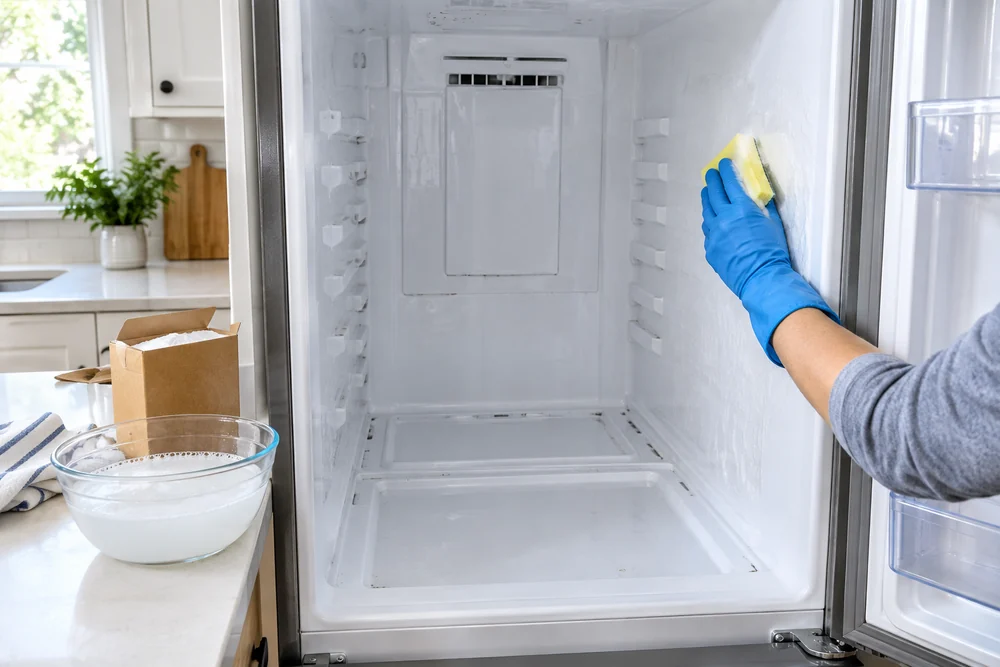
How to remove stubborn fridge odors
If the smell survives a full cleaning, the odor has soaked into the plastic liner or seals. Extension food safety experts suggest running the empty fridge with an odor absorber inside for a few days. Pick one method:
- Activated charcoal. Spread it in shallow pans on the shelves. The UNL Extension suggests running the empty appliance for 2 or 3 days; Texas A&M says to leave it several days and replace the charcoal if needed.
- Baking soda. Spread a layer on trays rather than leaving it in a closed box. More surface area means more contact with the air.
- Fresh coffee grounds. Spread freshly ground coffee on cookie sheets for 2 or 3 days.
- Crumpled newspaper. Pack the shelves with it and set a cup of water on the top shelf. The UNL Extension says this takes about 5 or 6 days but works on strong odors.
- Vanilla extract. GE suggests a little vanilla in a dish in the fresh food compartment (not the freezer) to leave a pleasant smell once the source is gone.
Texas A&M also lists a vinegar wash, 1 cup of vinegar per gallon of water, as an alternative to the baking soda solution. Never use it together with bleach.
How to get rid of smell in the freezer
Freezer odors usually come from old ice, unwrapped food and freezer burn. Throw out the ice in the bin and anything that’s been in there too long, wash the bin and walls with the baking soda solution, and dry it well. Store food airtight.
After a power outage
According to the FDA, a refrigerator keeps food safe for about 4 hours if the door stays closed, and a full freezer holds its temperature for about 48 hours. After that, perishable food in the fridge needs to go. If the outage lasted days and spoiled food leaked, clean and sanitize as above, then run the empty fridge with charcoal or newspaper. If odors have soaked into the insulation, both UNL and Texas A&M say home remedies may not work, and you’ll need a technician or the manufacturer.
The products that help
Cleaning removes the source. These keep the fridge fresh between cleanings and help you hold a safe temperature. Our picks are based on manufacturer specs, expert guidance and patterns in verified owner reviews.
Easiest everyday option
ARM & HAMMER Fridge-n-Freezer Odor Absorber
Best for: everyday odor control in the fridge and freezer after a good cleaning.
Why we picked it
- Baking soda with a vented, spill-resistant design
- Works in both the fresh food and freezer compartments
- Very strong owner ratings across thousands of reviews
Keep in mind
- Absorbs mild everyday smells; it won’t fix a leak or spoiled food
- Replace it on the schedule printed on the box
Best for stubborn odors
Fridge Ninja Activated Charcoal Deodorizer (2-Pack)
Best for: lingering smells that baking soda hasn’t cleared, or a second unit for the freezer.
Why we picked it
- Activated charcoal, the method extension experts suggest for strong odors
- Two units: one for the fridge, one for the freezer
- Compact enough to sit on a door shelf
Keep in mind
- Still needs the source cleaned out first
- Follow the maker’s instructions on when to replace it
Know your temperature
Rubbermaid Commercial Refrigerator/Freezer Thermometer
Best for: checking that your fridge stays at 40°F or below and the freezer at 0°F.
Why we picked it
- Simple dial, no batteries
- Hangs on a shelf or stands on its own
- Strong owner ratings across thousands of reviews
Keep in mind
- Dial thermometers take a while to settle; check after the door has been closed a bit
If you’d rather skip disposables, Moso Natural bamboo charcoal bags are a reusable option: the maker says to recharge them in the sun. They work best for mild, everyday smells.
How to keep your refrigerator from smelling
- Keep it at 40°F or below. The FDA recommends 40°F (4°C) or lower for the fridge and 0°F (-18°C) for the freezer, and checking an appliance thermometer at least once a week.
- Wipe spills right away. The FDA notes that cleaning regularly and wiping spills immediately helps reduce Listeria growth and stops drips from thawing meat from spreading to other food.
- Store meat on the bottom shelf. Keep raw meat, poultry and fish in a container or on a plate so juices can’t drip onto shelves below.
- Cover everything. Use airtight containers for leftovers and strong foods like onions, cheese and fish.
- Do a weekly clean-out. Toss old leftovers and wipe a shelf or two. Don’t leave perishable food out more than 2 hours (1 hour above 90°F), as the FDA advises.
- Replace the water filter on schedule. Follow your model’s filter indicator. Whirlpool, for example, recommends replacing refrigerator water filters every 6 months. Toss the first batches of ice after a change.
- Refresh the odor absorber. Swap baking soda or charcoal on schedule.
- Watch the produce drawer. Soft or rotting fruit draws pests too. If you’ve noticed tiny flies around the kitchen, our guide on how to get rid of fruit flies helps.
If the whole kitchen smells, not just the fridge, the source may be the trash, the disposal or a drain. Our guide on how to get rid of bad odors in your house walks through each room, and gnats hovering around a drain are covered in how to get rid of gnats in the house.
When to call a technician
Call an appliance technician or the manufacturer if the smell comes back within days of a full cleaning, if you smell something burning, electrical or chemical, if the fridge won’t hold 40°F or below, if water keeps pooling inside or under the unit (a blocked drain or leak), or if odors soaked into the insulation after a long outage. Both UNL and Texas A&M Extension note that insulation odors may require replacing the liner or insulation, or may not be fixable at home. A sweet chemical smell near the back could also signal a refrigerant problem, which only a certified technician should handle.
Frequently asked questions
How long does it take to get rid of a fridge smell?
If you find and remove the source, most smells are gone the same day after cleaning. Lingering odors usually fade within 2 or 3 days with activated charcoal or baking soda on trays, according to extension guidance. Very strong odors after an outage can take about a week using crumpled newspaper, and odors in the insulation may need a technician.
Does baking soda really absorb fridge odors?
It helps with mild, everyday odors, and GE recommends a box in both the fresh food and freezer compartments. It works better spread on a tray, and it won’t fix a smell whose source is still in the fridge.
Can I use vinegar to clean my refrigerator?
Yes. Texas A&M AgriLife Extension lists 1 cup of vinegar per gallon of water as an alternative to the baking soda solution. Rinse with clean water, dry well, and never combine vinegar with bleach.
Why does my fridge smell even after cleaning?
Usually because the source wasn’t found: check under crisper drawers, in the door gasket folds, the drain hole on the back wall and the drip pan. Old ice and an overdue water filter also hold odors. If everything is clean, the smell may be in the liner; a few days of activated charcoal usually helps.
What temperature should my refrigerator be?
The FDA recommends keeping the refrigerator at or below 40°F (4°C) and the freezer at 0°F (-18°C). The dial on many fridges isn’t a thermometer, so use an appliance thermometer and check it at least weekly.
Is it safe to eat food from a fridge that smells bad?
Judge each item, not the smell of the fridge. Throw out anything spoiled, leaking or past its date, and anything that sat above 40°F for more than about 4 hours during an outage, per FDA guidance. Smell isn’t a reliable safety test, since food can carry illness-causing bacteria without smelling off. When in doubt, throw it out.
Musty smells that aren’t coming from food are often mold. If you spot fuzzy growth on the gasket or nearby walls, our guide on how to get rid of mold and mildew covers safe cleanup.